
| Affiliate Disclosure: ClarityPick Experts may earn a commission from qualifying purchases made through links on this page, at no extra cost to you. We only recommend products we’d genuinely consider buying ourselves. |
A good electric pressure washer turns an hour of scrubbing a driveway, deck, or siding into about ten minutes of actual work — but the PSI and GPM numbers on the box are often more marketing than measurement. ClarityPick Experts researched four of 2026’s most popular electric pressure washers — the Sun Joe SPX3000, Karcher K1700, Westinghouse ePX3100, and Greenworks 2100 PSI — to see which one actually delivers on its spec sheet.
All four are light-duty electric units built for driveways, patios, cars, and siding, not professional gas-powered deep cleaning — but within that category, build quality, included accessories, and honest spec reporting vary more than you’d expect.
What Actually Matters in an Electric Pressure Washer
“Max PSI” vs. Rated PSIManufacturers advertise a “max PSI” figure measured under ideal lab conditions that’s rarely what you get in real use. Several brands now also publish a lower “rated” or “measured” PSI alongside the headline number — when you see both, the rated figure is the more honest one to compare across brands. GPM Matters as Much as PSIPSI tells you how hard the water hits; GPM (gallons per minute) tells you how much water is doing the work. Two washers with the same PSI but different GPM will clean at noticeably different speeds — higher GPM rinses away loosened dirt and soap faster, which matters more for larger surfaces like driveways. |
Nozzle SelectionA 0° nozzle is a pinpoint jet strong enough to etch wood or strip paint if held too close; a 40° nozzle is wide and gentle enough for cars and siding. A turbo nozzle combines a narrow, rotating jet for extra cleaning power without the full risk of a 0° tip. More nozzle options mean more control over how aggressive the spray is for a given surface. Portability & StabilityWheels, a telescoping handle, and a low center of gravity all make a unit easier to move around a yard without tipping over mid-spray — worth checking if you’re cleaning a large driveway or moving between a car, a deck, and siding in one session. |
Quick Comparison Table
| Product | Best For | Max PSI | Max GPM | Hose Length | Price |
|---|---|---|---|---|---|
| Sun Joe SPX3000 | Best Value | 2030 (advertised) | ~1.76 (varies by source) | Not stated | ~$130–$160 |
| Karcher K1700 | Best Build Quality | 1700 (measured) | 1.1 (measured) | 20 ft | ~$189.99 |
| Westinghouse ePX3100 | Best Safety Features | 2300 (advertised) / 1900 rated | 1.76 max / 1.24 rated | 25 ft | ~$199.00 |
| Greenworks 2100 PSI | Best for Portability | 2100 (advertised) | 1.2 | Not stated | ~$199.99 |
Editor’s Choice
|
|
|
1. Sun Joe SPX3000 — Best Value
|
Best For: Anyone who wants a capable, affordable pressure washer for occasional driveway, patio, and car-washing duty. |
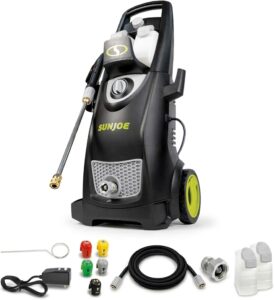
The SPX3000 is one of the best-selling electric pressure washers on Amazon for a reason — it ships with five interchangeable nozzle tips (0°, 15°, 25°, 40°, and a dedicated soap nozzle) and two onboard detergent tanks, so you can switch between a pinpoint jet for stuck-on grime and a wide, gentle fan for cars or siding without digging through a parts bag. At about 24 lbs, it’s also one of the lighter units here.
Sun Joe advertises 2030 max PSI and roughly 1.76 GPM, the highest headline numbers in this comparison — but independent testing has measured real-world output closer to 1500 PSI under load, with the motor drawing about 11 amps against its advertised 14.5-amp rating. That’s a meaningful gap between the box and reality, though it’s a pattern common across the budget electric pressure washer category, not unique to this model.
At roughly $130–$160 depending on sales, it undercuts every other washer in this guide while still matching or beating their included accessories. For occasional use — washing a car, rinsing a deck, knocking dirt off a driveway a few times a season — the gap between advertised and measured pressure is unlikely to be noticeable in practice.
|
Note: Sun Joe’s advertised 2030 PSI / 1.76 GPM figures are higher than what independent testing has measured in real-world use (closer to 1500 PSI). This gap between marketing and measured performance is common across this entire product category, not specific to Sun Joe. |
2030 PSI
Advertised Max
5
Nozzle Tips
2
Detergent Tanks
24 lbs
Weight
|
Pros ✓ Cheapest option in this comparison |
Cons ✗ Advertised PSI/GPM higher than measured real-world output |
|
ClarityPick Verdict: The best starting point for most buyers — strong accessory bundle, lowest price, and plenty of pressure for typical home cleaning jobs. |
| Check Price on Amazon → |
2. Karcher K1700 — Best Build Quality
|
Best For: Buyers who want the most honestly-rated specs here and a brand with decades of pressure-washer engineering behind it. |
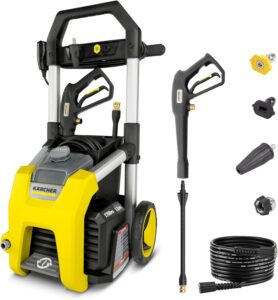
Karcher is the German brand that effectively invented the modern home pressure washer, and the K1700 reflects that pedigree in a detail competitors often skip: its listed 1700 PSI and 1.1 GPM are labeled “Measured Pressure” and “Measured Flow” rather than an inflated max figure, which makes it the most straightforwardly honest spec sheet in this comparison even though the headline number looks lower on paper than the Sun Joe or Westinghouse.
It ships with three nozzle tips — 40°, Turbo, and Foaming — a narrower selection than the Sun Joe’s five, but the Turbo nozzle combines a rotating, concentrated jet that cleans faster than a standard fan tip without the paint-stripping risk of a 0° nozzle. The 20-foot high-pressure hose is also longer than what either the Sun Joe or Greenworks publishes, giving more reach around a vehicle or along a fence line before you need to reposition the unit.
At $189.99 and 20.7 lbs, it sits in the middle of this group on both price and weight. It doesn’t include a dedicated onboard detergent tank the way the Sun Joe and Westinghouse do — the Foaming nozzle handles soap application instead, which works but is a different workflow if you’re used to a built-in tank.
|
Note: The K1700’s 1700 PSI figure is lower than the Sun Joe’s or Westinghouse’s advertised numbers, but it’s a measured spec rather than a max/lab figure — in practical terms, real-world performance across these four washers is closer than the headline PSI numbers suggest. |
1700 PSI
Measured Pressure
20 ft
Hose Length
3
Nozzle Tips
20.7 lbs
Weight
|
Pros ✓ Honestly labeled “measured” specs, not inflated max figures |
Cons ✗ No dedicated onboard detergent tank |
|
ClarityPick Verdict: If you’d rather buy on honestly reported specs than the biggest number on the box, the K1700 is the one to trust. |
| Check Price on Amazon → |
3. Westinghouse ePX3100 — Best Safety Features
|
Best For: Anyone cleaning on uneven ground or moving the unit frequently, where tip-over risk is a real concern. |
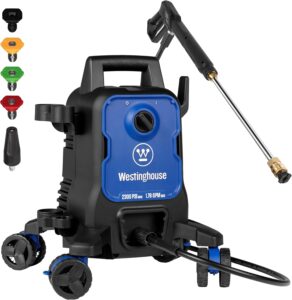
Westinghouse built the ePX3100 around a specific design problem: top-heavy pressure washers that tip over when you yank the hose at an angle. The fix here is a 16.5-inch-tall body with a genuinely low center of gravity, paired with four quick-lock wheels that steer a full 360° — Westinghouse markets this combination as “anti-tipping technology,” and it’s a feature none of the other three washers in this guide specifically call out.
It ships with five quick-connect nozzle tips (0°, 15°, 25°, turbo, and a dedicated soap applicator) plus a 20oz onboard soap tank, and its 25-foot braided hose is the longest in this comparison — four feet more than the Karcher’s 20-foot hose. At 19 lbs dry weight, it’s also the lightest unit here before you add the water hose and attachments.
Like the Sun Joe, its spec sheet has some inconsistency worth flagging: Westinghouse’s own page lists 2300 max PSI in one place and a 1900 “rated” PSI in another, with GPM similarly split between a 1.76 max and 1.24 rated figure. Go by the rated numbers (1900 PSI / 1.24 GPM) for realistic expectations, and treat the higher max figures as lab-condition ceilings you won’t see in everyday use.
|
Note: Westinghouse’s own marketing is internally inconsistent on this unit’s PSI — 2300 max appears in one spot and 1900 rated in another. Use the 1900 PSI / 1.24 GPM “rated” figures for realistic expectations rather than the higher max numbers. |
25 ft
Hose Length
20oz
Soap Tank
5
Nozzle Tips
19 lbs
Dry Weight
|
Pros ✓ Anti-tip design with low center of gravity |
Cons ✗ Inconsistent PSI/GPM figures on the brand’s own site |
|
ClarityPick Verdict: The longest hose and the only real anti-tip design in this group make it a solid pick if stability and reach matter more to you than the lowest price. |
| Check Price on Amazon → |
4. Greenworks 2100 PSI — Best for Portability
|
Best For: Buyers who’ll be rolling the unit around the yard a lot and want wheels and a telescoping handle built in. |
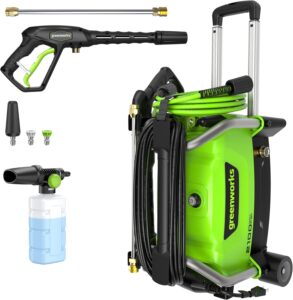
Greenworks built this unit specifically around portability — it’s sold as a “Portable Pressure Washer with Wheels + Telescoping Handle,” which makes it easier to roll across a driveway or lawn than units you have to carry or drag by the hose. It’s rated 2100 max PSI at 1.2 GPM, running on a 13-amp universal motor.
The included accessory set is solid: a spray nozzle, a metal quick-connect wand, and four nozzle tips covering 25°, 40°, soap application, and a turbo setting for faster cleaning on tougher grime. The product page describes “kink-resistant hoses” but doesn’t publish an exact hose length or unit weight, which makes it harder to directly compare reach and portability specs against the Karcher’s stated 20-foot hose or the Westinghouse’s 25-foot hose.
At $199.99, it’s the most expensive of the four — tied closely with the Westinghouse — without a clearly superior spec sheet to justify the premium over the Sun Joe. The wheels and telescoping handle are the real differentiator here, not raw cleaning power.
|
Note: Greenworks doesn’t publish hose length or unit weight for this model — if those specs matter for your specific use case, you may need to check current product photos or customer Q&A before buying. |
2100 PSI
Max Pressure
1.2 GPM
Flow Rate
4
Nozzle Tips
13A
Motor
|
Pros ✓ Wheels + telescoping handle for easy repositioning |
Cons ✗ Hose length and weight not published |
|
ClarityPick Verdict: Worth it if rolling the unit around the yard easily matters more to you than squeezing out every last PSI — otherwise the Sun Joe does the core job for less. |
| Check Price on Amazon → |
Buyer’s Guide: Which One Should You Actually Buy?
|
If you want the best value for occasional home use: the Sun Joe SPX3000 gives you the most nozzles and tanks for the least money — just don’t expect the advertised 2030 PSI in practice. If you’d rather trust honestly reported specs over the biggest number on the box: the Karcher K1700’s measured PSI/GPM figures and 20-foot hose make it the straightest-shooting option here. If you’re worried about the unit tipping over on uneven ground: the Westinghouse ePX3100’s low center of gravity and four-wheel base are purpose-built for that, plus the longest hose of the four. If you’ll be moving the washer around a large yard frequently: the Greenworks’s telescoping handle and wheels make repositioning easier than carrying or dragging a unit by its hose. |
Frequently Asked Questions
|
Why do pressure washer PSI numbers vary so much between the box and reviews? Most brands advertise a “max PSI” measured under ideal lab conditions with no hose or nozzle attached, which is higher than what you’ll see with a hose, nozzle, and real water pressure in the mix. Some brands, like Karcher here, publish a “measured” or “rated” figure instead, which is a more honest real-world estimate. |
|
Is 1700 PSI enough to clean a driveway? Yes — all four washers in this guide, including the Karcher at 1700 PSI, fall in the range considered adequate for driveways, patios, decks, siding, and vehicles. You’d need a gas-powered unit in the 3000+ PSI range for heavy-duty concrete stripping or commercial work, which isn’t what any of these four are built for. |
|
What’s the difference between a 0° and a 40° nozzle? A 0° nozzle produces a pinpoint jet with no spread — powerful enough to etch wood, strip paint, or damage soft surfaces if held too close. A 40° nozzle produces a wide fan spray that’s gentle enough for cars, siding, and general rinsing. Always start with a wider nozzle and test on an inconspicuous spot before narrowing the spray. |
|
Can I use a pressure washer to wash my car? Yes, with the right nozzle — a wide-angle tip (25° or 40°) kept at least a foot or two from the surface is standard for car washing. Never use a 0° pinpoint nozzle on a vehicle’s paint or glass, since it can chip paint or crack a windshield at close range. |
Final Verdict
|
Sun Joe SPX3000 — Best Value. 5 nozzles, dual soap tanks, 24 lbs. ~$130–$160. Karcher K1700 — Best Build Quality. Honestly measured specs, 20 ft hose, Turbo nozzle. ~$189.99. Westinghouse ePX3100 — Best Safety Features. Anti-tip design, 25 ft hose, lightest at 19 lbs. ~$199.00. Greenworks 2100 PSI — Best for Portability. Wheels + telescoping handle, turbo nozzle. ~$199.99. |
For most home driveway, patio, and car-washing needs, the Sun Joe SPX3000 remains the easiest recommendation on price and included accessories, while the Karcher K1700 is the one to trust if honestly reported specs matter more to you than the biggest number on the box.

4 Best Luxury Face Moisturizers 2026: La Mer vs Charlotte Tilbury vs Tatcha — Ranked
4 Best BCAA Supplements 2026 — Tested & Ranked for Muscle Recovery, Purity & Value

5 Best Luxury Anti-Aging Eye Creams 2026: La Mer, Charlotte Tilbury & More — Ranked

4 Best Magnesium Sprays & Lotions 2026 — Tested & Ranked for Muscle, Sleep & Relief

5 Best Beef Liver/Organ Supplements 2026 — Tested & Ranked for Purity & Nutrition
4 Best Hydrogen Water Bottles 2026 — Tested & Ranked for Output & Verification

3 Best Sauna Blankets 2026 — Tested & Ranked for Heat & Safety

4 Best Nootropic Supplements 2026 — Tested & Ranked for Focus & Memory

5 Best Mushroom Coffee Products 2026 — Tested & Ranked for Focus & Clean Energy

5 Best Probiotics 2026 — Tested & Ranked for Gut Health, Strain Diversity & Value

5 Best Greens Powders 2026 — Tested & Ranked for Probiotics, Organic Certification & Value

5 Best Hair Growth Supplements 2026 — Tested & Ranked for Women, Thinning Hair & Real Results

5 Best Red Light Therapy Devices 2026 — Tested & Ranked for Skin & Recovery

5 Best Joint Supplements 2026 — Tested & Ranked for Pain Relief & Mobility

5 Best CoQ10 Supplements 2026 — Tested & Ranked for Heart Health, Energy & Anti-Aging
5 Best Zinc Supplements 2026 — Tested & Ranked for Immunity, Testosterone & Skin

5 Best Collagen Peptides for Skin 2026 — Tested & Ranked for Elasticity, Hydration & Nails

5 Best Lion’s Mane Supplements 2026 — Tested & Ranked for Brain, Focus & Nerve Health

5 Best Multivitamins 2026 — Tested & Ranked for Men, Women & Daily Nutrition